



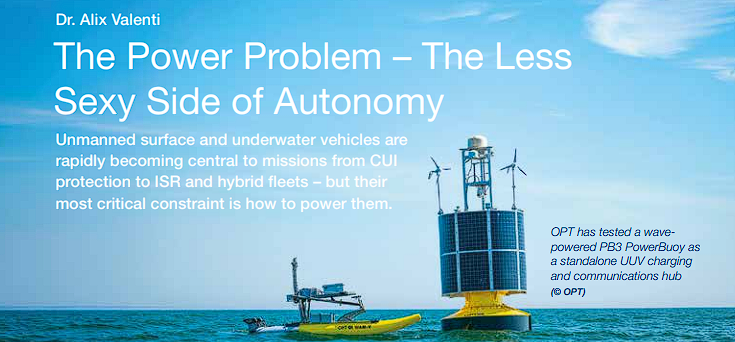
Unplugged has been featured in the latest edition of MS&D Magazine in an article examining one of the most important challenges facing autonomous maritime systems: how to provide the energy needed for persistent operations at sea.
In “The Power Problem – The Less Sexy Side of Autonomy,” defence journalist Dr. Alix Valenti explores the energy challenge facing unmanned surface and underwater vehicles as their missions expand across critical underwater infrastructure monitoring, intelligence, surveillance and reconnaissance, and future hybrid naval fleets.
Speaking with MS&D, Dr. Thomas J.J. Meyer, CGO of Unplugged, highlights the fundamental relationship between endurance, cost and autonomy. Today, many UUVs remain constrained by battery endurance, and whenever a vehicle has to be recovered or physically connected for charging, human intervention is reintroduced into what should otherwise be an autonomous operation.
Unplugged addresses this challenge through inductive wireless subsea charging. A receiver integrated into the underwater vehicle communicates with a charging pad installed on a fixed, floating or towed infrastructure. Once the vehicle approaches the charging station, Unplugged’s homing and docking technologies enable the final precision approach before power and data transfer take place autonomously.
As Dr. Meyer explains in the article:
“The charger is the product. Persistent underwater presence is the outcome, and interoperability is how we deliver it.”
The operational impact is already being demonstrated. MS&D reports that Unplugged charging stations have completed more than 800 dockings in real-world deployments. The article also describes a Saipem vehicle with a 12-hour battery lifetime that, following integration of Unplugged technology, has been operating in eight-month residency missions.
For Unplugged, the objective extends beyond charging individual vehicles. The goal is to provide the energy infrastructure that enables persistent autonomous underwater operations: reducing dependence on vessel recovery, human intervention and repeated mobilisation.
As maritime autonomy scales, the ability to recharge underwater and across different vehicle platforms will become an increasingly important part of the subsea infrastructure required to support persistent operations.
Read the full article in MS&D Magazine: The Power Problem – The Less Sexy Side of Autonomy, by Dr. Alix Valenti.